Quality Food
September 9, 2026
Comment(0)
Why Open-Fire Cooking Delivers Better Flavour: The Science, Tradition, and Taste of Live Fire Grilling
There is a reason that food cooked over an open flame tastes different from anything produced in a conventional oven or on a flat-top grill. It is not nostalgia. It is not marketing. It is chemistry, physics, and thousands of years of culinary evolution working in perfect harmony to produce flavours that no other cooking method can replicate.
At Olives Meze Shawarma in Tooting Market, open-fire and charcoal cooking are central to who we are and what we serve. Our charcoal specials menu exists precisely because we believe that the live fire cooking technique is not simply one option among many. It is the superior method for producing the bold, complex, smoky grilled flavour that defines authentic Mediterranean grilling. This article explains why, in detail.
A Brief History of Open-Fire Cooking
Humans have been cooking over open fire for at least 250,000 years, and probably significantly longer. Archaeological evidence from sites across Africa and Europe shows that early humans understood and harnessed fire to transform raw food into something more digestible, safer, and more flavourful. Anthropologist Richard Wrangham has argued extensively that cooking over fire was central to human cognitive development, with the increased caloric efficiency of cooked food freeing biological energy for brain growth.
In the Mediterranean specifically, open-fire cooking was the dominant culinary method for millennia. Ancient Greek and Roman texts describe elaborate grilling traditions for meat and fish. Turkish, Lebanese, and North African cuisines developed their own distinct live fire techniques around charcoal and wood, producing the traditions that inform restaurants like ours today.
The fact that open-fire cooking has survived the invention of gas hobs, electric ovens, air fryers, and every other piece of modern kitchen technology is not an accident. It has survived because nothing else produces the same result.
The Maillard Reaction: The Science Behind Grilled Flavour
The most important chemical process in grilled food is the Maillard reaction, named after French chemist Louis-Camille Maillard who first described it in the early twentieth century. The Maillard reaction occurs when amino acids and reducing sugars in food are exposed to high heat, typically above 140 degrees Celsius, and begin to react with one another. The result is the formation of hundreds of new flavour and aroma compounds simultaneously.
This is the reaction responsible for the golden-brown crust on grilled meat, the complex savoury depth in well-seared proteins, and the roasted, slightly bitter edge that makes char-grilled food so satisfying. The Maillard reaction does not occur in boiling or steaming because water limits the surface temperature of food to 100 degrees Celsius. It is the high, direct heat of an open flame that makes the chemistry possible.
Open-fire grilling delivers this high-intensity surface heat more efficiently and consistently than most conventional cooking methods. Charcoal, in particular, burns at temperatures between 700 and 900 degrees Celsius, far exceeding what a standard domestic oven or gas hob can produce. This is why charcoal-grilled food develops a depth of crust and flavour that other methods simply cannot match.
Smoke as a Flavour Ingredient
The second major flavour-generating mechanism of open-fire cooking is smoke. When fat drips from meat onto hot charcoal or burning wood, it vaporises and produces a complex mixture of volatile organic compounds. These compounds, including guaiacol and syringol, are responsible for the characteristic smoky aroma and flavour that is impossible to reproduce with liquid smoke or synthetic flavouring.
Research published in food chemistry literature confirms that the specific flavour compounds produced by smoke vary depending on the type of fuel used. Charcoal produces a relatively clean, neutral smoke. Hardwoods like oak, cherry, and mesquite each contribute distinct aromatic profiles. The food absorbs these compounds through its surface, creating a multi-layered flavour that permeates the outer crust while leaving the interior moist and tender.
At Olives Meze Shawarma, our charcoal specials are developed with this in mind. The smoky grilled flavour you taste in dishes like our lamb adana is not added after cooking. It is built into the cooking process itself, an inseparable product of the live fire method.
Radiant Heat and the Texture Advantage
Open-fire cooking delivers heat through three distinct mechanisms simultaneously: radiation (direct heat from the flame), conduction (heat transferred through the grill grate), and convection (hot air circulating around the food). This combination of heat sources is unique to live fire cooking and results in a specific texture profile that is difficult to replicate through any other single method.
The outer surface of grilled meat cooked over charcoal develops a firm, caramelised crust through the Maillard reaction and direct radiant heat. Simultaneously, the interior of the protein retains moisture because the intense surface heat creates a kind of seal that prevents excessive moisture loss. The result is a piece of meat that is charred and deeply flavoured on the outside while remaining juicy and tender within.
This is the specific texture our customers describe when they talk about the difference between our charcoal-grilled dishes and food they have eaten elsewhere. It is not magic. It is the physics of live fire cooking done properly.
The Importance of Marination in Live Fire Cooking
One of the most important factors in authentic open-fire grilling is the marination process that precedes it. A good marinade does several things at once. Acidic components like lemon juice or yogurt begin to break down surface proteins, making the outer layer more receptive to the Maillard reaction. Oils carry fat-soluble spice compounds into the muscle fibres, distributing flavour evenly throughout the protein. Salt penetrates deep into the tissue through osmosis, enhancing juiciness and overall flavour.
At Olives Meze Shawarma, our proteins are marinated overnight. This is not a minor detail. It is a fundamental part of why our grilled dishes taste the way they do. When a chicken or lamb piece goes onto the charcoal grill having been marinated for 12 to 18 hours in our house spice blend, the flavour development during cooking is incomparably richer than anything that can be achieved with a quick coating applied before service.
The combination of an authentic spice marinade and a live fire cook is what makes dishes like our lamb adana charcoal special genuinely different from anything you will find in a chain restaurant. Both elements are necessary. Neither alone is sufficient.
Traditional Mediterranean Grilling Techniques
Different Mediterranean cultures developed distinct live fire cooking techniques, each with its own characteristics and resulting flavour profiles.
Mangal grilling
Used extensively in Turkish cuisine, mangal grilling involves cooking directly over charcoal in a long, narrow grill vessel. The proximity of the food to the charcoal, combined with the ability to adjust the height of the grill, gives the cook precise control over temperature and char level. Adana kebab, a hand-minced lamb preparation on flat skewers, is the definitive mangal dish and a direct inspiration for our lamb adana charcoal special.
Saj cooking
Found across the Levant, a saj is a convex metal disc heated over fire and used to cook flatbreads and thin meats at very high speed. The intense heat of the curved metal surface creates a characteristic char and puff in flatbreads that no oven can replicate. The bread that wraps our shawarma and grills is informed by this tradition.
Shish cooking
Shish, meaning skewer in Turkish and Arabic, is one of the oldest grilling formats in the Mediterranean and Middle East. Threading marinated cubes of meat onto metal or wooden skewers and cooking them directly over flame ensures even exposure to heat and smoke while allowing the cook to manage doneness with great precision. Our mixed grill and skewer dishes follow this tradition.
Why Charcoal Outperforms Gas in Professional Grilling
The debate between charcoal and gas cooking is one that food professionals have engaged with seriously. Gas grills offer convenience and temperature consistency, but they lack two key attributes that define the live fire cooking experience: high-intensity heat and smoke.
Gas burns cleanly and does not produce the fat-drip vaporisation that creates smoke flavour compounds. The maximum temperature of a gas grill is also typically lower than that of well-established charcoal, which limits the depth of Maillard browning achievable. Professional cooks and culinary researchers consistently identify charcoal as the superior medium for developing the flavour complexity that defines authentic grilled food.
This is precisely why our charcoal specials menu at Olives Meze Shawarma exists as a distinct category. The dishes on that menu are prepared specifically with charcoal to achieve a flavour depth that our standard grill dishes, excellent as they are, simply do not produce. When you order our lamb adana charcoal special or our chicken charcoal dish, you are ordering food that could only taste the way it does because of the fuel it was cooked over.
The Sensory Experience of Live Fire Cooking
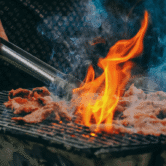
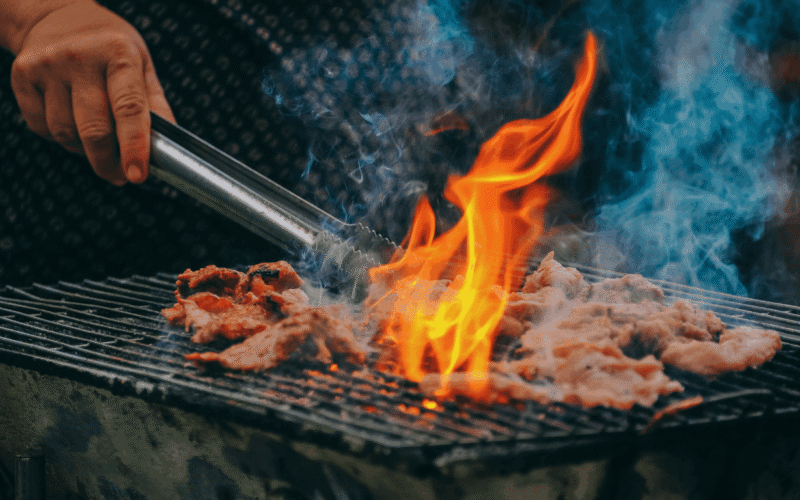
Beyond the chemistry, it is worth acknowledging the purely sensory dimension of open-fire cooking. The visual drama of food on a grill, the sound of fat hitting hot charcoal, the smell of smoke and spice combining in the air around the cooking station: all of these elements prime the diner before they have taken a single bite.
Food science research into sensory anticipation and flavour perception confirms that the multisensory environment in which food is encountered significantly affects how it is experienced. Hearing, seeing, and smelling a charcoal grill in action genuinely makes the food taste better by activating anticipatory responses in the brain before consumption begins.
At our Tooting Market kitchen, the grill is not hidden. The cooking is part of the experience. When you walk into Olives Meze Shawarma, you encounter the food with all of your senses before you sit down. That is intentional.
Open-Fire Cooking and the Mediterranean Diet
From a nutritional standpoint, open-fire grilling is also one of the healthiest cooking methods available. Grilling over charcoal allows excess fat to drip away from the protein during cooking, reducing the overall fat content of the finished dish compared to frying or pan-cooking in oil. The high-heat crust formation also means that fewer additional fats need to be added during the cooking process.
The Mediterranean dietary pattern, which centres on lean proteins, vegetables, legumes, and olive oil, is specifically complemented by grilling as a cooking method. It is no coincidence that some of the world’s healthiest and longest-lived populations, particularly in Greece, Turkey, and Lebanon, have grilling traditions at the core of their food culture.
Our menu at Olives Meze Shawarma reflects this philosophy. Whether you choose from our charcoal specials, our mixed grill, our protein gym boxes, or our fresh salad selections, you are eating food prepared in a way that prioritises quality and nutritional integrity alongside flavour.
Experience Authentic Open-Fire Cooking at Olives Meze Shawarma
If you want to understand what live fire cooking actually delivers in practice, come and visit us. Olives Meze Shawarma is located at Unit 3, Tooting Market, 20 Totterdown Street, London SW17 8TA. We are open Sunday to Thursday from 11am to 10pm, and Friday to Saturday from 11am to 11:30pm. You can also order via Uber Eats, Deliveroo, or Just Eat for delivery across South London.
We believe that the best argument for open-fire cooking is the food itself. Come and let our charcoal grill make the case.
Everything You Need to Know
Discover what makes authentic charcoal grilling, traditional Mediterranean techniques, and our food at Olives Meze Shawarma special.
When fat and juices from food drip onto hot charcoal, they vaporise and produce complex smoke compounds that re-deposit onto the food's surface. Gas burns cleanly and does not produce this effect. The result is that charcoal-grilled food develops a genuine smoke flavour that gas grilling cannot replicate.
Generally, yes. Grilling over an open fire allows excess fat to drip away from the protein during cooking, reducing the overall fat content of the finished dish. It also requires minimal added oil compared to frying. Combined with the use of fresh ingredients and authentic spice marinades, open-fire grilling is one of the most nutritionally sound cooking methods for meat and poultry.
Well-established charcoal burns at temperatures between 700 and 900 degrees Celsius. This extreme heat is what drives the Maillard reaction at the food's surface and creates the caramelised crust and depth of flavour characteristic of authentic charcoal-grilled food. These temperatures are significantly higher than those achievable on a standard domestic gas or electric hob.
The Maillard reaction is a chemical process that occurs when amino acids and reducing sugars in food are exposed to high heat. It produces hundreds of new flavour and aroma compounds and is responsible for the golden-brown crust, complex savoury depth, and characteristic char flavour of grilled food. It is the single most important flavour-generating process in open-fire cooking.
Significantly, yes. A quality marinade applied over an extended period, we recommend a minimum of several hours and overnight for the best result, tenderises the outer proteins, distributes flavour compounds into the muscle fibres, and enhances the Maillard reaction during cooking. The flavour difference between a properly marinated piece of meat and one that has been quickly seasoned before grilling is substantial.
Our kitchen is informed by mangal grilling traditions from Turkish cuisine, as well as the shish and skewer cooking methods common across the wider Mediterranean and Middle East. Our charcoal specials, including our lamb adana, are prepared using live fire charcoal techniques that reflect these authentic regional methods.
Olives Meze Shawarma at Tooting Market is one of South London's most celebrated destinations for genuine charcoal-grilled Mediterranean food. Our charcoal specials menu, alongside our full range of grills, wraps, meze, and shawarma, is prepared fresh daily using authentic techniques and overnight-marinated ingredients. Find us at Unit 3, Tooting Market, SW17 8TA, or order online through Uber Eats, Deliveroo, or Just Eat.