Quality Food
August 3, 2026
Comment(0)
What Makes Levantine Cuisine Different From Other Middle Eastern Food?
When most people hear the phrase ‘Middle Eastern food,’ they picture shawarma, hummus, and flatbreads. And they are not wrong.
But ‘Middle Eastern cuisine’ is a broad umbrella that spans an enormous range of cultures, cooking techniques, climates, and flavor traditions—from the Gulf to the Levant, from North Africa to Anatolia. Grouping it all together does a disservice to each region’s extraordinary culinary identity.
At Olives Meze Shawarma, nestled inside the vibrant heart of Tooting Market in South London, we cook Levantine food. Not a generalised version of Middle Eastern cuisine — the real thing. And we think it is worth explaining exactly what that means, because once you understand what sets Levantine cooking apart, you begin to appreciate every element on your plate in an entirely new way.
This guide breaks down the history, geography, spice philosophy, techniques, and defining dishes that make Levantine cuisine one of the most distinctive and nuanced food traditions anywhere in the world.
What Is the Levant, and Why Does Geography Matter in Food?
The Levant refers to the eastern coastal region of the Mediterranean, encompassing modern-day Lebanon, Syria, Jordan, Palestine, and parts of southern Turkey and northern Israel.
It is a region shaped by millennia of cultural exchange—Phoenician traders, Roman occupation, Byzantine rule, Ottoman governance, and Silk Road commerce have all left their mark on the land and, inevitably, on its food.
Geography is the invisible hand behind every cuisine. The Levant benefits from a Mediterranean climate: mild, wet winters and long, dry summers. This produces an abundance of olives, tomatoes, aubergines, courgettes, pomegranates, figs, citrus, and fresh herbs.
The proximity to the sea brings fish and seafood traditions to coastal communities, while the fertile inland valleys support wheat cultivation, chickpeas, and lentils.
Compare this to the Arabian Peninsula, where the harsher desert climate historically shaped a cuisine built more around meat preservation, rice, dried dates, and robust spice blends designed to work with limited fresh produce.
Or to Persian cuisine, further east, where saffron, dried fruits, pomegranate molasses, and delicate layering of sweet and sour define the palate. Each region is distinct, and the Levant stands apart with its emphasis on freshness, brightness, and olive oil as the foundation of almost everything.
The Levantine Spice Philosophy: Layered, Not Loud
One of the most significant ways Levantine cuisine differs from other Middle Eastern food traditions is in its approach to spice. In Persian or Gulf cooking, you often encounter bold, heavily spiced dishes where the spice blend is the defining feature. Levantine cooking takes a more nuanced approach.
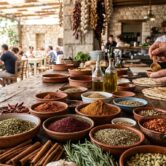
The signature spice mixture of the Levant is za’atar, a blend of dried thyme, sumac, sesame seeds, and salt that is used as a condiment, a marinade, a bread topping, and a flavour enhancer across countless dishes. Sumac itself — a deep crimson, tart berry ground into powder — is another quintessentially Levantine ingredient that adds acidity and brightness without heat.
Seven-spice (baharat), allspice, cinnamon, coriander, and cumin are all used in Levantine cooking, but they are employed with restraint. The goal is to enhance the natural flavour of the primary ingredient — whether that is lamb, chicken, fish, or aubergine — rather than to overpower it. Fresh herbs such as flat-leaf parsley, mint, and coriander are used generously and added at the point of serving to preserve their brightness.
At Olives Meze Shawarma, this philosophy runs through everything we cook. Our marinades are developed in-house, our spice blends are our own, and we believe that the best shawarma in London is not the one with the most aggressive seasoning — it is the one where every layer of flavour reveals itself gradually, from the first bite to the last.
The Meze Tradition: Why Sharing Is Central to Levantine Dining
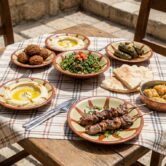
Perhaps the most culturally distinctive element of Levantine dining is the concept of meze — a spread of small dishes served together, designed to be shared, explored, and savoured slowly. Meze is not a starter course that precedes a main. It is a way of eating, a philosophy of hospitality, and a social act.
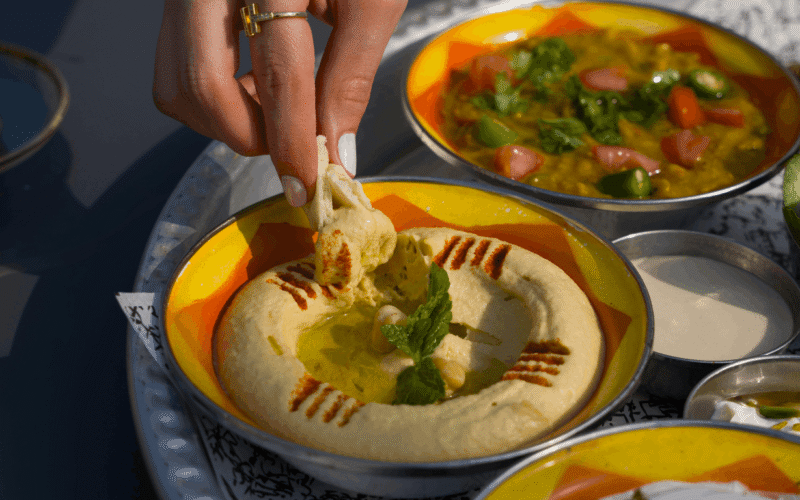
A traditional Levantine meze spread might include hummus (ground chickpeas with tahini and lemon), baba ganoush (fire-roasted aubergine), tabbouleh (a herb-forward bulgur salad with tomato and lemon), fattoush (toasted bread salad), kibbeh (bulgur and minced lamb croquettes), stuffed vine leaves, olives, pickled vegetables, and warm flatbreads. These dishes arrive together, filling the table, and guests eat communally — pulling, dipping, scooping, and passing.
This stands in contrast to, say, Gulf or Saudi cuisine, where the tradition leans more towards large central platters of rice and meat — dishes like kabsa or mandi, which are generous and celebratory but structured differently around a single centrepiece rather than a constellation of smaller plates.
At Olives Meze Shawarma, we bring this meze culture to Tooting Market. Our meze selection is prepared fresh daily — the kind of hummus and baba ganoush that tastes unmistakably handmade, because it is. We believe that the shared table is the soul of Levantine dining, and we have built our menu around that principle.
The Role of Bread in Levantine Cuisine
In the Levant, bread is not an accompaniment. It is a utensil, a vehicle, a comfort, and in many cases the centrepiece of the meal. Khubz (flatbread) and its many regional variations are baked fresh throughout the day and serve as the primary way to eat everything from meze dips to grilled meats.
The shawarma wrap is perhaps the most globally recognised expression of Levantine bread culture — thinly sliced, marinated meat packed into fresh bread with vegetables, herbs, pickles, and sauces. But the wrap form also extends to falafel, kofte, grilled chicken, and halloumi, all of which benefit from the softness and slight char of well-made flatbread.
Our wraps at Olives Meze Shawarma are built around fresh bread that complements rather than competes with the filling. Whether you choose our chicken shawarma wrap, falafel wrap, or halloumi wrap, the bread is always an active participant — soft, warm, and fresh.
Levantine Cuisine vs Other Middle Eastern Food Traditions: A Comparison
To truly understand Levantine cuisine, it helps to compare it with neighbouring traditions:
Levantine vs Persian Cuisine
Persian food is defined by the interplay of sweet and sour — pomegranate molasses, dried barberries, saffron, and dried fruits appear regularly in rice dishes and stews. It is more complex and layered in a sweet-savoury direction. Levantine food is sharper and brighter: acid comes from lemon and sumac, sweetness is rare and restrained, and the emphasis is on herbs and freshness over slow-cooked richness.
Levantine vs Gulf Cuisine
Gulf cuisine — particularly Saudi, Emirati, and Kuwaiti food — places rice at the heart of the meal. Dishes like kabsa, mandi, and machboos are slow-cooked rice and meat preparations with warm, aromatic spice blends often incorporating rose water, dried lime (loomi), and black pepper. Levantine cuisine is less rice-focused, leaning instead towards breads, legumes, and fresh vegetables as the primary staples.
Levantine vs Turkish Cuisine
Turkish food shares significant overlap with Levantine cooking, given the Ottoman Empire’s centuries of influence across the Levant. Grilled meats, flatbreads, kebabs, and meze-style small plates all appear in both traditions. However, Turkish cuisine has distinct regional identities — from the dairy-heavy, tomato-rich Central Anatolian cooking to the olive oil-dominated Aegean coast — and incorporates techniques and ingredients less common in the Levant, such as stuffed pastry (borek), fermented dairy dips, and more liberal use of butter.
At Olives Meze Shawarma, our menu is firmly rooted in the Levantine tradition. When you order a charcoal grill from us — whether that is lamb adana, kofte, or our mix grill — you are eating within a cooking tradition that prizes quality of ingredient, technique of preparation, and the kind of flavour depth that only comes from proper marination and live-fire cooking.
What Defines Authentic Levantine Flavours?
If we had to identify the core pillars of authentic Levantine flavour, they would be these:
Olive oil as a base, not a finishing touch. Levantine cooking is fundamentally built on olive oil. It appears in marinades, dressings, dips, and as the cooking medium for vegetables and proteins alike.
Lemon and sumac for brightness. Acidity plays a central role in Levantine cooking. A squeeze of lemon over a meze plate, sumac dusted on grilled meats, or pomegranate seeds scattered across a salad — brightness is always present.
Fresh herbs, used abundantly. Flat-leaf parsley, mint, and fresh coriander are not garnishes in Levantine cooking — they are ingredients, used by the handful. Tabbouleh is fundamentally a parsley dish with some bulgur, not the other way around.
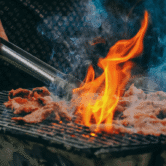
Fire and smoke. Charcoal grilling is a cornerstone of Levantine meat cookery. The char on a kofte, the smoke in a baba ganoush made from fire-roasted aubergine, or the caramelisation on a shawarma cone — fire adds a dimension that no other cooking method replicates.
Legumes as equal-status proteins. Chickpeas, lentils, and fava beans are not supporting characters in Levantine cuisine. Falafel, hummus, and ful medames are full dishes with centuries of culinary tradition behind them.
Every element of our menu at Olives Meze Shawarma is designed around these defining pillars. From our falafel — hand-made and fried to order — to our overnight-marinated shawarma and our fresh meze selection, we cook the way the Levant has always cooked: with honesty, with fire, and with flavour that does not need to shout to be heard.
Why Levantine Cuisine Is Having Its Moment in London
London’s food culture has never been more curious, more global, or more discerning. Diners are increasingly moving beyond generalist labels and seeking out regional specificity — not just ‘Middle Eastern food’ but Lebanese shawarma, Levantine meze, Palestinian musakhan, or Syrian kibbeh. The appetite for authentic, origin-rooted cuisine is genuinely growing.
Levantine food also resonates strongly with the contemporary move towards plant-forward eating. The tradition’s deep reliance on vegetables, legumes, olive oil, and fresh herbs means it translates naturally to vegetarian and vegan diets without compromise or substitution. The food was always this way — the plant-based dishes are not adaptations; they are originals.
At Olives Meze Shawarma, we have seen first-hand how Tooting Market’s diverse, food-literate community has embraced Levantine cooking. Our regulars span every background and dietary preference — and they all find something genuine on our menu, whether they are lifelong fans of Mediterranean food or discovering it properly for the first time.
Taste Levantine Cuisine at Olives Meze Shawarma, Tooting Market
If you have read this far and feel the pull of a proper shawarma, a table of fresh meze, or a charcoal grill platter, we would love to feed you. We are located at Unit 3, Tooting Market, 20 Totterdown Street, London SW17 8TA — easy to reach on the Northern line at Tooting Broadway station.
Real food. Real flavour. Right here in Tooting Market.
faqs
frequently asked questions ?
What is the difference between Levantine food and Middle Eastern food?
What are the most iconic Levantine dishes?
Is Levantine food spicy?
Is Levantine food good for vegetarians and vegans?
What makes shawarma a specifically Levantine dish?
What makes Levantine shawarma distinctive is the specific spice marinade (typically including cumin, coriander, cinnamon, and allspice), the fresh accompaniments (garlic sauce, pickles, tomatoes, herbs), and the wrapping in fresh flatbread.
At Olives Meze Shawarma, ours is marinated overnight in our own spice blend and cooked to order — the way shawarma is supposed to be made.