Quality Food
October 15, 2026
Comment(0)
The Science Behind Smoky Grilled Meat: What Really Creates That Charcoal Taste
Ask anyone why they love grilled meat and most people will say something simple: it just tastes better. That instinctive response is not an exaggeration. Food cooked over charcoal genuinely does produce a richer, deeper, more complex flavour than food prepared by almost any other method. But why? The answer lies in chemistry, heat physics, and a set of reactions that only occur when food meets a live flame. At Olives Meze Shawarma, our charcoal grill is at the centre of everything we do at Tooting Market in South London, and understanding the science behind it helps explain why our customers keep returning for dishes like our Lamb Adana Charcoal Special and Mix Grill.
This article breaks down the real science behind smoky grilled meat flavour, what charcoal does that other heat sources cannot, and why grilling chemistry is as fascinating as the food it produces.
The Starting Point: What Is Flavour, Exactly?
Before we get into the chemistry, it is worth establishing what flavour actually is. When we describe something as tasty, we are actually processing a combination of taste (detected by receptors on the tongue), aroma (processed through the nose), texture (felt in the mouth), and temperature. Of these, aroma is responsible for a significant portion of our overall flavour perception.
This is why the smell of grilling meat is so compelling before you even take a bite. The aromatic compounds released during charcoal grilling are hitting your olfactory system and priming your flavour expectation before the food even reaches your plate. By the time you eat it, your brain is already engaged with what is coming. Grilling chemistry begins in the air around the grill, not just on the plate.
Reaction 1: The Maillard Reaction
The Maillard reaction is the single most important chemical process in cooking for flavour development, and charcoal grilling is one of the best ways to trigger it. Named after French chemist Louis-Camille Maillard, who first described it in the early 1900s, this reaction occurs between amino acids (the building blocks of proteins) and reducing sugars when they are exposed to heat above approximately 140 degrees Celsius.
On a charcoal grill, surface temperatures can easily exceed 250 to 300 degrees Celsius. At these temperatures, the Maillard reaction occurs rapidly and extensively, producing a cascade of hundreds of new chemical compounds simultaneously. These compounds are responsible for:
Brown Colour
The golden-brown crust that forms on grilled meat is a direct visual product of the Maillard reaction.
Complex Aroma
Many of the hundreds of compounds produced are volatile, meaning they evaporate and enter the air as aromatic molecules, contributing directly to the smell of grilled food.
Depth of Flavour
The Maillard compounds themselves are flavour-active, meaning they stimulate taste receptors in ways that raw or boiled protein cannot. The resulting flavour is layered, savoury, and deeply satisfying.
At Olives Meze Shawarma, the charcoal-grilled crust on our Lamb Adana, Chicken Grill, and Grilled Lamb Kofte is the direct result of the Maillard reaction occurring at the right temperature for the right amount of time. Achieving this consistently requires skill and experience, which is exactly what our kitchen team brings to the grill every day.
Reaction 2: Fat Pyrolysis and Drip Flare-Up
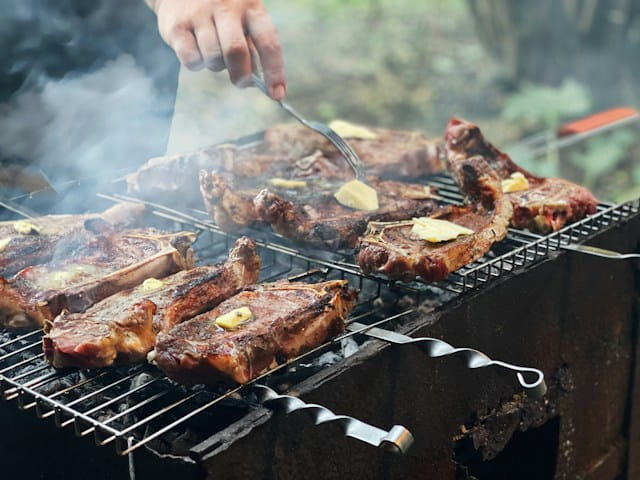
Charcoal grilling has a unique feature that gas grilling and oven cooking lack: the proximity of the food to the fuel source, with the gap between them being the site of a continuous chemical exchange. When fat and meat juices drip from the food down onto the hot charcoal, they do not simply disappear. They undergo a process called pyrolysis, which is the chemical decomposition of organic material through high heat.
During pyrolysis, the fat breaks down into a range of compounds including alkenes, aldehydes, and polycyclic aromatic compounds. Some of these volatilise instantly and rise back up as smoke, landing on the food above and adding a layer of complex, savoury smokiness. This process is the primary source of the charcoal flavour profile that food lovers associate with authentic grilled meat.
The key point here is that this cycle of dripping and smoke-rising is self-reinforcing throughout the cooking process. Every time juices drip, more smoke is generated, and more of those aromatic compounds are deposited on the meat. This is a continuous flavour-building process that simply does not occur in a gas oven or an air fryer.
Reaction 3: Phenolic Compounds from Wood Combustion
Charcoal is produced by burning wood in low-oxygen conditions, and even after it has been converted into charcoal, it retains some of the chemical characteristics of the wood it came from. When charcoal burns during grilling, it releases smoke containing a class of compounds called phenols, and particularly a molecule called guaiacol.
Guaiacol and related phenolic compounds are the primary contributors to what we recognise as the smoky, woody, slightly sweet flavour in charcoal-grilled food. These compounds are created during the thermal decomposition of lignin, a structural polymer found in all wood. When guaiacol vapour contacts the surface of meat, it binds to the fat and proteins there, becoming part of the flavour structure of the food itself.
Different types of charcoal and wood produce slightly different phenolic profiles, which is why the smoke from oak charcoal tastes different to that from fruitwood. At Olives Meze Shawarma, we use charcoal that produces the clean, rich smoke that complements our Mediterranean marinades without overpowering them. The balance between the smoke and the spice is a deliberate choice, not a happy accident.
Why Charcoal Tastes Better Than Gas
This is a question that often comes up in cooking discussions, and the science gives a clear answer. Gas grilling produces a very clean flame with few byproducts. The combustion of propane or natural gas creates primarily carbon dioxide and water vapour, with very little in the way of aromatic compounds. This means that gas-grilled food benefits from the Maillard reaction but receives almost none of the smoke infusion and phenolic compound deposition that charcoal grilling provides.
In practical terms, this means gas-grilled food tastes seared and can develop a good crust, but it lacks the deep, layered smokiness that characterises charcoal grilling. The flame-grilled taste that people specifically seek out in Mediterranean and Middle Eastern restaurants is a charcoal flavour.
This is why Olives Meze Shawarma uses a charcoal grill rather than a gas-fired appliance for our grill menu. We want the food we serve to carry the full flavour profile that comes from the complete grilling chemistry process, not a simplified version of it.
The science behind the flavour: Charcoal grilling combines browning through the Maillard reaction, aromatic smoke from dripping juices, and phenolic compounds from combustion to build a distinctive flavour profile.
The Role of Marinades in Grilling Chemistry
Marinades play a significant scientific role in the flavour of charcoal-grilled meat, going beyond simply adding surface taste. When meat is marinated, particularly in acidic mixtures containing citrus juice, yoghurt, or vinegar, the acid begins to denature proteins at the surface of the meat. This creates a slightly different protein structure that, when it hits the heat of the charcoal, undergoes the Maillard reaction in a distinct way compared to unmarinated meat.
Marinades that contain sugar, whether from honey, fruit juice, or sweet spices such as cinnamon and allspice, introduce reducing sugars that participate directly in the Maillard reaction, intensifying the caramelisation and browning on the surface of the meat and producing more Maillard compounds.
At Olives Meze Shawarma, our marinades are developed in-house and applied overnight, giving the spice blend time to penetrate deeply into the meat. When that meat then hits our charcoal grill, the interaction between the marinated surface and the high heat is what produces the distinctive, layered flavour in dishes like our Lamb Adana Charcoal Special and our signature shawarma. We do not use pre-made marinades or flavour shortcuts. Every blend is ours.
Smoke as a Preservation and Flavour Tool: A Brief History
The science of smoky grilled meat is ancient, even if the chemistry was not formally understood until recently. Archaeological evidence suggests that humans have been cooking over wood fires for at least 300,000 years. Early cooks noticed that meat smoked over fire lasted longer and tasted distinctively different to raw or boiled food. The preservation effect of smoke comes from the antimicrobial properties of phenolic compounds, particularly syringol and guaiacol, which inhibit bacterial growth on the surface of smoked meat.
The flavour effect of smoke was so valued that communities developed specific techniques for maximising it, selecting particular woods, controlling airflow around the fire, and learning which fuels produced the most desirable aromatic profiles. Mediterranean grilling traditions, which form the foundation of our cooking at Olives Meze Shawarma, carry forward thousands of years of refinement in exactly these techniques.
What Makes Our Charcoal Grill at Tooting Market Different
Understanding the science of grilling chemistry makes it clear why the grill itself matters. Not all charcoal grills are the same. The distance from the fuel to the food, the temperature of the charcoal, the quality of the fuel, the technique of the cook, and the composition of the food being grilled all interact to produce the final result.
At Olives Meze Shawarma, our grill is managed by a team that understands these variables and adjusts for them constantly. We do not rush the process. Our chicken pieces are positioned at the right distance from the coals to sear properly without burning. Our kofte are turned at the right moment to preserve their moisture. Our Lamb Adana is given the time it needs to develop a proper crust while remaining tender internally.
The result is food that reflects the full scientific process we have described in this article: a deep Maillard crust, phenolic smoke infusion from quality charcoal, and the natural fat-basting cycle that comes from real open-fire cooking. When you order from our Charcoal Special menu, you are tasting the product of that entire chemical process, applied with genuine skill and care.
Visit Us in Tooting Market
If the science behind smoky grilled meat has left you wanting to taste it for yourself, we would love to have you visit us. Olives Meze Shawarma is located at Unit 3, Tooting Market, 20 Totterdown Street, London SW17 8TA. We are open from 11am every day, with late-night service until 11:30pm on Fridays and Saturdays.
Our Charcoal Special menu features our Lamb Adana, Mix Grill, Chicken Grill, and Grilled Lamb Kofte, all cooked over a live charcoal grill using the techniques and processes described throughout this article. You can dine in at Tooting Market, collect your order directly from our kitchen, or have it delivered through Just Eat, Deliveroo, or Uber Eats.
Real food. Real flavour. The science is in every bite.
Frequently Asked Questions
Discover the chemistry behind charcoal grilling, smoky meat flavour and traditional Mediterranean cooking.
The two primary reactions are the Maillard reaction, which occurs between amino acids and reducing sugars at high heat and creates hundreds of new flavour and aroma compounds, and fat pyrolysis, which happens when dripping meat juices hit the hot charcoal and vaporise as aromatic smoke. A third process involves phenolic compounds released from the burning charcoal, particularly guaiacol, which deposit on the meat surface and create the signature smoky taste.
Gas grilling produces a clean flame with very few byproducts, meaning food benefits from searing heat but receives less smoke infusion and phenolic compound deposition. Charcoal grilling, by contrast, combines Maillard browning, smoke from dripping fats, and phenolic compounds from charcoal combustion. This combination creates a layered flavour that differs from gas grilling.
Guaiacol is a phenolic compound associated with the woody, smoky, slightly sweet flavour profile of charcoal-grilled food. When guaiacol vapour contacts the surface of meat during grilling, it contributes to the flavour of the dish. Different charcoals can produce different smoke profiles, which is why fuel quality matters to the final taste.
Yes. Marinades containing acids can alter surface proteins, while marinades containing sugars introduce ingredients that participate in browning reactions. These effects influence flavour and texture during grilling. At Olives Meze Shawarma, we marinate our meat overnight to develop flavour before it reaches the charcoal grill.
Charcoal can produce surface temperatures of 250 to over 300 degrees Celsius, depending on the fuel, airflow and distance from the coals. This intense heat supports rapid browning on the meat's surface. Skilled grill cooks manage cooking speed and crust development by controlling the distance between the food and the coals.
Olives Meze Shawarma at Tooting Market serves dishes from its charcoal grill, including Lamb Adana Charcoal Special, Chicken Grill, Grilled Lamb Kofte and Mix Grill. Visit Unit 3, Tooting Market, 20 Totterdown Street, London SW17 8TA, or order through Just Eat, Deliveroo and Uber Eats.
